Living Standards in the Past :New Perspectives on Well-Being in Asia and Europe
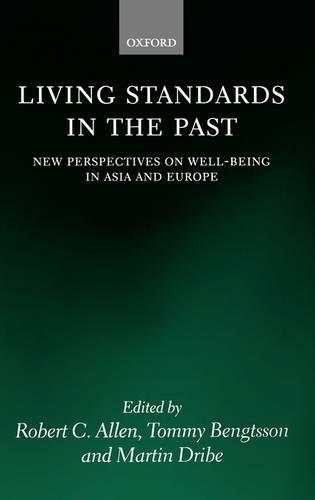
Living Standards in the Past

Living Standards in the Past :New Perspectives on Well-Being in Asia and Europe

hardback
Published: 24 March, 2005
Standard worldwide delivery by Thu, July 30 - Tue, August 4
Order within 0
Condition: NEW
$402.06
Price includes shipping
Available 20+ in stock
- +
FREE Returns within 30 days

Description

Why did Europe experience industrialisation and modern economic growth before China, India or Japan? This is one of the most fundamental questions in Economic History and one that has provoked intense debate. The main concern of this book is to determine when the gap in living standards between the East and the West emerged. The established view, dating back to Adam Smith, is that the gap emerged long before the Industrial Revolution, perhaps thousands of years ago. While this view has been called into question - and many of the explanations for it greatly undermined - the issue demands much more empirical research than has yet been undertaken. How did the standard of living in Europe and Asia compare in the seventeenth and eighteenth centuries? The present book proposes an answer by considering evidence of three sorts. The first is economic, focusing on income, food production, wages, and prices. The second is demographic, comparing heights, life expectancy and other demographic indicators. The third combines the economic and demographic by investigating the demographic vulnerability to short-term economic stress. The contributions show the highly complex and diverse pattern of the standard of living in the pre-industrial period. The general picture emerging is not one of a great divergence between East and West, but instead one of considerable similarities. These similarities not only pertain to economic aspects of standard of living but also to demography and the sensitivity to economic fluctuations. In addition to these similarities, there were also pronounced regional differences within the East and within the West - regional differences that in many cases were larger than the average differences between Europe and Asia. This clearly highlights the importance of analysing several dimensions of the standard of living, as well as the danger of neglecting regional, social, and household specific differences when assessing the level of well-being in the past.
See more

More Details

Type Book
ISBN13 9780199280681
ISBN10 0199280681
Number Of Pages 496
Item Weight 889 g
Product Dimensions 164 x 241 x 32 mm
Publisher / Reseller Oxford University Press
Format hardback
See More +

Media Reviews

If you are interested in human welfare, you will enjoy this book. Accessible in style, ranging broadly over space and time, innovative in method,'living standards in the past' brings together works by some of the foremost practitioners in the field. * Continuity and Change *

Show more

Author's Bio

Robert Allen is Professor of Economic History at Oxford University and a fellow of Nuffield College. He received his doctorate from Harvard University. He has written extensively on English agricultural history, international competition in the steel industry, the extinction of whales, the global history of wages and prices, and contemporary policies on education. His articles have won the Cole Prize, the Redlich Prize, and the Explorations Prize. His books include Enclosure and the Yeoman: The Agricultural Development of the South Midlands, 1450-1850, which was awarded the Ranki Prize by the Economic History Association, and, most recently, Farm to Factory: A Re-interpretation of the Soviet Industrial Revolution. Professor Allen is a Fellow of the British Academy and the Royal Society of Canada. Tommy Bengtsson, Professor of Demography and Economic History at Lund University, works in both historical and contemporary economic demography. He has served in leading positions in Swedish and international organisations and is currently Chair of the IUSSP Committee on Historical Demography and Series Co-editor of the Eurasian Population and Family History Series. Martin Dribe is Associate Professor of Economic History at Lund University.

Show more