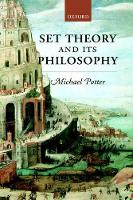
Set Theory and its Philosophy :A Critical Introduction
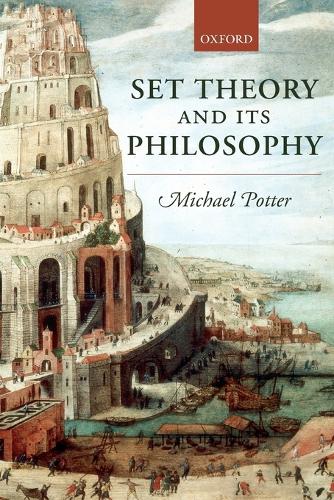
Set Theory and its Philosophy :A Critical Introduction
paperback
Published:
15 January, 2004
paperback
Published:
15 January, 2004

Standard worldwide delivery by
Thu, July 16 - Tue, July 21
Order within
0
Popular Books by Michael Potter
View All Books by Michael Potter
Description
Michael Potter presents a comprehensive new philosophical introduction to set theory. Anyone wishing to work on the logical foundations of mathematics must understand set theory, which lies at its heart. Potter offers a thorough account of cardinal and ordinal arithmetic, and the various axiom candidates. He discusses in detail the project of set-theoretic reduction, which aims to interpret the rest of mathematics in terms of set theory. The key question here is how to deal with the paradoxes that bedevil set theory. Potter offers a strikingly simple version of the most widely accepted response to the paradoxes, which classifies sets by means of a hierarchy of levels. What makes the book unique is that it interweaves a careful presentation of the technical material with a penetrating philosophical critique. Potter does not merely expound the theory dogmatically but at every stage discusses in detail the reasons that can be offered for believing it to be true. Set Theory and its Philosophy is a key text for philosophy, mathematical logic, and computer science.
More Details
| Type | Book |
|---|---|
| ISBN13 | 9780199270415 |
| ISBN10 | 0199270414 |
| Number Of Pages | 360 |
| Item Weight | 524 g |
| Product Dimensions | 155 x 233 x 18 mm |
| Publisher / Reseller | Oxford University Press |
| Format | paperback |
See More +
Media Reviews
a wonderful new book . . . Potter has written the best philosophical introduction to set theory on the market * Timothy Bays, Notre Dame Philosophical Reviews *
Author's Bio
Michael Potter is University Lecturer in Philosophy, and Fellow of Fitzwilliam College, at Cambridge. He is the author of Sets (1990), on which the present work draws but which was written for a more specialist readership, and Reason's Nearest Kin (2000).