Making Mathematical Culture :University and Print in the Circle of Lefèvre d'Étaples - Oxford-Warburg Studies
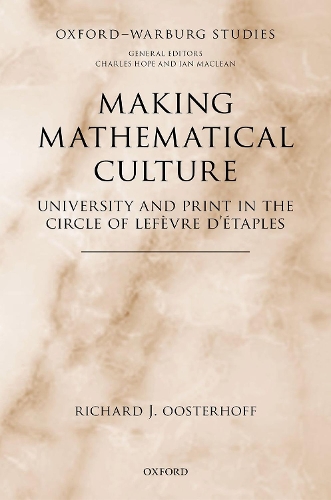
Making Mathematical Culture :University and Print in the Circle of Lefèvre d'Étaples - Oxford-Warburg Studies
hardback
Published:
14 August, 2018

Popular Books by Richard J. Oosterhoff
View All Books by Richard J. Oosterhoff
Description
More Details
| Type | Book |
|---|---|
| ISBN13 | 9780198823520 |
| ISBN10 | 0198823525 |
| Number Of Pages | 292 |
| Item Weight | 616 g |
| Product Dimensions | 163 x 238 x 23 mm |
| Publisher / Reseller | Oxford University Press |
| Format | hardback |
Media Reviews
Oosterhoff's book is a first-rate scholarly work. Through his sharp and intelligent scrutiny of the dense (and prolific) printed Latin oeuvres generated by Lefèvre and other members of the Fabrist circle, the author reveals a fascinating and transformative late fifteenth- and early sixteenth-century pedagogical era in which mathematics was not only considered for its practical purposes but also contemplated for "regulating the soul as it realizes its larger goals of knowledge" (49). This book is certainly as important to Renaissance Paris as Andrew Warwick's Masters of Theory (2003) is to Victorian Cambridge. I highly recommend the book to early modern intellectual scholars who desire a broader understanding of French humanism and to historians of science seeking earlier origins of the mathematical way in natural philosophy. * Jean-François Gauvin, Université Laval, Renaissance Quarterly *
Oosterhoff has given us an exciting, creative, and well-documented work. It considerably advances our understanding of the cognitive history of the book and of the central role of mathematics in the early modern university, and it should become a mainstay of examination lists and bibliographies. * Abram Kaplan, Junior Fellow at the Society of Fellows at Harvard University, Isis Journal of the History of Science Society *
Author's Bio
Richard Oosterhoff is a Postdoctoral Research Associate at the University of Cambridge, and a fellow at CRASSH where he is researching a monograph on the 'untutored mind' in Early Modern Europe. Richard completed his PhD in 2013 at the University of Notre Dame, and has since worked on the cultural and intellectual history of early modern Europe in the areas of science, the book, and religion. His articles have appeared in the Journal for the History of Ideas, Intellectual History Review, The Stanford Encyclopedia of Philosophy, and History of Universities.