Poland's Last King and English Culture :Stanislaw August Poniatowski, 1732-1798 - Oxford Historical Monographs
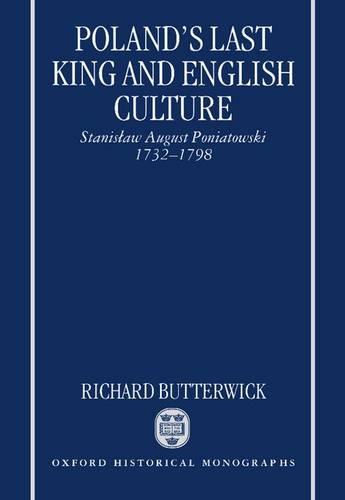
Poland's Last King and English Culture :Stanislaw August Poniatowski, 1732-1798 - Oxford Historical Monographs
hardback
Published:
12 March, 1998

Popular Books by Richard Butterwick
View All Books by Richard Butterwick
Description
More Details
| Type | Book |
|---|---|
| ISBN13 | 9780198207016 |
| ISBN10 | 0198207018 |
| Number Of Pages | 400 |
| Item Weight | 626 g |
| Product Dimensions | 146 x 224 x 27 mm |
| Publisher / Reseller | Oxford University Press |
| Format | hardback |
Media Reviews
Richard Butterwick makes an important new contribution to our knowledge ... Butterwick's book is based on extensive research. His comprehensive discussion of Polish-English cultural contacts comes from fresh archival material. The political sections, while including archival material, come mostly from a review of Polish historiography of the 1990s which is unknown to English-language readers. * Daniel Stone, The International History Review XXI.2 June 1999 *
Butterwick is a young but extremely well-read historian less interested in Stanislaw August's efficacy or political afterlife than in the reforms he had attempted during his reign as well as the possible influence of the English model on his projects and decisions. * George Gomori, Journal of Europena Studies XXX *
Butterwick has produced a meticulously researched and elegantly written account of Stanislaw's fascination with English cultural, intellectual and political life... Butterwick demonstrates convincingly through a close analysis of Stanislaw's writing on government not only that the Polish king had a serious commitment to the political reform of Poland... but also that the English form of government was an important model for him... Butterwick skillfully demonstrates the significance of English ideas in Polish constitutional thought. * Journal of Modern History *
The sheer thoroughness of Richard Butterwick's research is very impressive ... an ... extremely interesting and illuminating book. * Jan Jederzejewski, Irish Slavonic Studies, Vol 19, 1998 *
Butterwick's superb scholarly study on a specific theme that touched almost every aspect of the king's career is an important contribution ... this study (based in both extensive archival research and a thorough mastery of the printed sources) throws Stanislaw and his reign into a new scholarship. * P. W. Knoll, CHOICE *
the first major work of scholarship to explore in depth, and on the basis of extensive archival research in Poland and England, the king's Anglophilia ... Butterwick tackles this task with eminent success; he writes elegantly and with a confidence born out of a thorough knowledge of his subject ... There is much here for the comparative historian. The book enriches our understanding of eighteenth-century Anglophilia and provides a new perspective on England's place in the enlightenment. In short, it is an impressive and stimulating achievement. * W.H. Zawadzki, Abingdon School, Oxon, EHR, June 1999 *