Fixing Democracy :Why Constitutional Change Often Fails to Enhance Democracy in Latin America
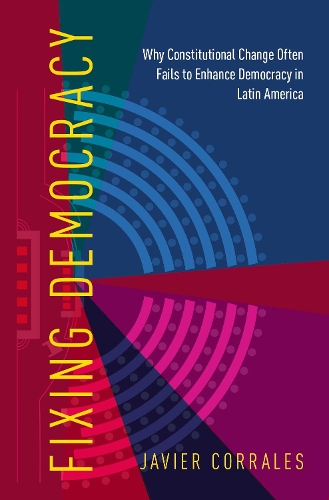
Fixing Democracy :Why Constitutional Change Often Fails to Enhance Democracy in Latin America
paperback
Published:
12 July, 2018

Popular Books by Javier Corrales
View All Books by Javier Corrales
Description
More Details
| Type | Book |
|---|---|
| ISBN13 | 9780190868901 |
| ISBN10 | 0190868902 |
| Number Of Pages | 288 |
| Item Weight | 399 g |
| Product Dimensions | 155 x 231 x 20 mm |
| Publisher / Reseller | Oxford University Press Inc |
| Format | paperback |
Media Reviews
This book is an important contribution to the field of neo-institutionalism in comparative politics. It fills a gap in knowledge of the reasons why presidential powers expand or contract in the context of the broader strength of democracy. * L. M. Barnett, Our Lady of the Lake University, CHOICE *
Author's Bio
Javier Corrales is Dwight W. Morrow 1895 Professor of Political Science at Amherst College and obtained his PhD in Government from Harvard University in 1996. He specializes in comparative politics and international relations of Latin America. He has written extensively on economic reforms, democratization, presidential powers, term limits, education policy and international relations. He has been a Fulbright scholar in Bogotá, Colombia, and Caracas, Venezuela. He is on the editorial board of Latin American Politics and Society and Americas Quarterly, and the European Review of Latin American and Caribbean Studies.