Grundrisse :Foundations of the Critique of Political Economy
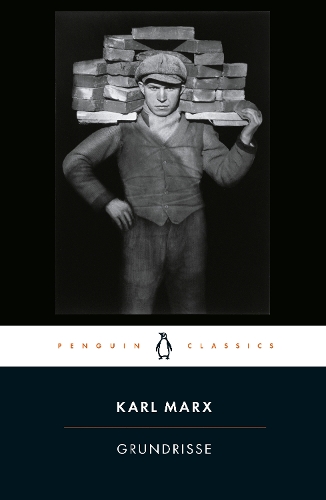
Grundrisse :Foundations of the Critique of Political Economy
paperback | English
Published:
29 April, 1993
paperback | English
Published:
29 April, 1993

Standard worldwide delivery by
Mon, July 6 - Thu, July 9
Order within
0
Condition:
NEW
$24.13
RRP
$25.45
You save $1.33 (5%)
Available
20+
in stock
FREE Returns within 30 days
Popular Books by Karl Marx
View All Books by Karl Marx



Description
Written during the winter of 1857-8, the Grundrisse was considered by Marx to be the first scientific elaboration of communist theory. A collection of seven notebooks on capital and money, it both develops the arguments outlined in the Communist Manifesto (1848) and explores the themes and theses that were to dominate his great later work Capital. Here, for the first time, Marx set out his own version of Hegel's dialectics and developed his mature views on labour, surplus value and profit, offering many fresh insights into alienation, automation and the dangers of capitalist society. Yet while the theories in Grundrisse make it a vital precursor to Capital, it also provides invaluable descriptions of Marx's wider-ranging philosophy, making it a unique insight into his beliefs and hopes for the foundation of a communist state.
More Details
| Type | Book |
|---|---|
| ISBN13 | 9780140445756 |
| ISBN10 | 0140445757 |
| Number Of Pages | 912 |
| Item Weight | 652 g |
| Product Dimensions | 128 x 197 x 49 mm |
| Publisher / Reseller | Penguin Books Ltd |
| Format | paperback |
See More +
GoodReads Reviews
Author's Bio
Karl Marx (1818-1883). The core of Marx's economic analysis found early expression in the Ökonomisch-philosophische Manuskripte aus dem Jahre 1844 (Economic and Political Manuscripts of 1844) (1844). There, Marx argued that the conditions of modern industrial societies invariably result in the estrangement (or alienation) of workers from their own labor. In his review of a Bruno Baier book, On the Jewish Question (1844), Marx decried the lingering influence of religion over politics and proposed a revolutionary re-structuring of European society. Much later, Marx undertook a systematic explanation of his economic theories in Das Kapital (Capital) (1867-95) and Theorien über den Mehrwert (Theory of Surplus Value) (1862).