Working Effectively with Legacy Code - Robert C. Martin Series
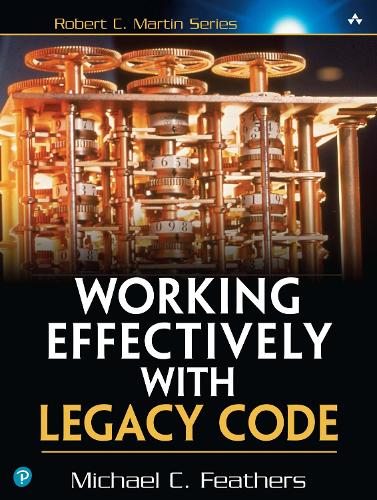
Working Effectively with Legacy Code - Robert C. Martin Series
paperback
Published:
14 October, 2004

Description
This book provides programmers with the ability to cost-effectively handle common legacy code problems without having to go through the hugely expensive task of rewriting all existing code. It describes a series of practical strategies that developers can employ to bring their existing software applications under control. The author provides useful guidance about how to use these strategies when refactoring or making functional changes to codebases.
One of the book's key points is that it teaches developers to write tests that can be used to ensure they are not unintentionally changing the application as they optimize it. Examples are provided in Java, C++, and C#, and the book assumes that the reader has some knowledge of UML notation. Strategies using UML and code in C++ and Java are emphasized, while language-independent advice is delivered in sidebars and appendices for language-specific users.
More Details
| Type | Book |
|---|---|
| ISBN13 | 9780131177055 |
| ISBN10 | 0131177052 |
| Number Of Pages | 464 |
| Item Weight | 740 g |
| Product Dimensions | 175 x 231 x 25 mm |
| Publisher / Reseller | Pearson Education (US) |
| Format | paperback |
GoodReads Reviews
Author's Bio
MICHAEL C. FEATHERS works for Object Mentor, Inc., one of the world's top providers of mentoring, skill development, knowledge transfer, and leadership services in software development. He currently provides worldwide training and mentoring in Test-Driven Development (TDD), Refactoring, OO Design, Java, C#, C++, and Extreme Programming (XP). Michael is the original author of CppUnit, a C++ port of the JUnit testing framework, and FitCpp, a C++ port of the FIT integrated-testing framework. A member of ACM and IEEE, he has chaired CodeFest at three OOPSLA conferences.
© Copyright Pearson Education. All rights reserved.