Peak :For Fans of Atomic Habits
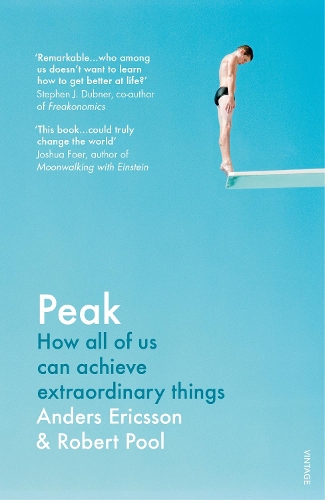
Peak :For Fans of Atomic Habits
paperback
Published:
20 April, 2017

Popular Books by Anders Ericsson
View All Books by Anders Ericsson
Description
Deliberate practice: your path to extraordinary performance
In Peak, psychologist Anders Ericsson, whose research inspired the famous “10,000-hour rule,” reveals what truly drives mastery - and it’s not talent. Drawing on three decades of much-admired, myth-shattering research, Ericsson shows that focused, purposeful practice can unlock exceptional skill in anyone.
Drawing on countless case-studies of musicians and athletes, surgeons and students, Peak offers actionable strategies to improve learning, motivation and performance. Ericsson's revolutionary methods will show you how to improve at almost any skill that matters to you, and that you don't have to be a genius to achieve extraordinary things.
Engaging, evidence-based and empowering, it’s the ultimate guide to achieving potential in work, sport and life.
‘Anyone who wants to get better at anything should read Peak’ Fortune
‘This book… could truly change the world’ Joshua Foer
‘Groundbreaking... brilliantly useful’ Daniel Coyle
‘Powerful... actually shows us how to get better (much better) at the things we care about’ Seth Godin
More Details
| Type | Book |
|---|---|
| ISBN13 | 9780099598473 |
| ISBN10 | 0099598477 |
| Number Of Pages | 336 |
| Item Weight | 238 g |
| Product Dimensions | 130 x 198 x 22 mm |
| Publisher / Reseller | Vintage Publishing |
| Format | paperback |
Media Reviews
Most “important” books aren’t much fun to read. Most fun books aren’t very important. But with Peak, Anders Ericsson (with great work from Robert Pool) has hit the daily double. After all, who among us doesn’t want to learn how to get better at life? A remarkable distillation of a remarkable lifetime of work -- Stephen J. Dubner, bestselling author of FREAKONOMICS
Offer[s] an optimistic anti-determinism that ought to influence how people educate children, manage employees and spend their time. * The Economist *
This book is a breakthrough, a lyrical, powerful, science-based narrative that actually shows us how to get better (much better) at the things we care about. -- Seth Godin, author of LINCHPIN
The science of excellence can be divided into two eras: before Ericsson and after Ericsson. His groundbreaking work, captured in this brilliantly useful book, provides us with a blueprint for achieving the most important and life-changing work a person can achieve: to become a little bit better each day. -- Daniel Coyle, bestselling author of THE TALENT CODE
Ericsson's research has revolutionized how we think about human achievement. He has found that what separates the best of us from the rest is not innate talent but simply the right kind of training and practice. If everyone would take the lessons of this book to heart, it could truly change the world. -- Joshua Foer, bestselling author of MOONWALKING WITH EINSTEIN
An invaluable exploration into the details of what makes the difference between simply going through the motions (for 10,000 hours!) and practising to reap significant improvement. A thought-provoking and extremely useful book. -- Harriet Beveridge, author of WILL IT MAKE THE BOAT GO FASTER?
His ultimate message is an uplifting, optimistic one and should be applauded. -- Nick Rennison * Daily Mail *
Invaluable. -- David Didau * Learning Spy *
The work of the academic psychologist Anders Ericsson has inspired half a dozen popular accounts of the relationship between talent and effort. This year, with the science writer Robert Pool, he produced a book of his own, Peak: Secrets from the New Science of Expertise (Bodley Head), which may be the liveliest and clearest of the lot. -- Leo Robson * Books of the Year, New Statesman *
The clear style helps cast new light on a subject I thought I understood. I found his discussion of mental representations and the distinction between purposeful and deliberate practice especially illuminating * Leaning Spy, Book of the Year *
GoodReads Reviews
Author's Bio
Professor Anders Ericsson is the world’s reigning expert on expertise. His research into what makes ordinary people achieve the extraordinary was the inspiration for the 10,000-hours rule – the popular theory that 10,000 hours of any type of practice will allow an individual to excel in any field. In this book, he describes how a particular type of extended practice leads to exceptional performance. Anders Ericsson began his research into expertise when he conducted a memory trial on a young man. Despite having no previous aptitude for memory exercises, after several hundred sessions the young man was displaying memory powers over 10 times that of an average person. This was as a result of the system of training Ericsson had put him through – a process Ericsson has named ‘deliberate practice’. Professor Ericsson has gone on to have his research widely cited in major newspapers and magazines worldwide, and he has worked with major international organisations, as well as Oxford, Stanford and Harvard medical schools, teachers and educational researchers, professional sports teams (Manchester City Football Club, Saracens Rugby Union Club, UK Sport, England and Wales Cricket Board), and military groups. Robert Pool is a science writer who has worked at some of the world’s most prestigious science publications, including Science and Nature, and his writing has appeared in many others. He is the author of three previous books.