
2.24Kg of CO2

280 litre(s) of Water

0.0168 Tree(s)

1 book donated to global literacy projects
Riders in the Chariot
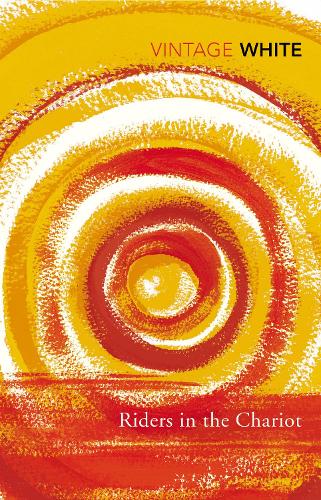
Riders in the Chariot
paperback
Published:
5 September, 1996


Popular Books by Patrick White
View All Books by Patrick White
Description
WITH AN INTRODUCTION BY DAVID MALOUF
Through the crumbling ruins of the once splendid Xanadu, Miss Hare wanders, half-mad. In the wilderness she stumbles upon an Aborigine artist and a Jewish refugee. They place themselves in the care of a local washerwoman. In a world of pervasive evil, all four have been independently damaged and discarded. Now in one shared vision they find themselves bound together, understanding the possibility of redemption.
More Details
| Type | Book |
|---|---|
| ISBN13 | 9780099323914 |
| ISBN10 | 0099323915 |
| Number Of Pages | 560 |
| Item Weight | 383 g |
| Product Dimensions | 129 x 198 x 33 mm |
| Publisher / Reseller | Vintage Publishing |
| Format | paperback |
Media Reviews
[A] monumental work [of more than] half a thousand pages -- almost every one of which cries out for quotation * New York Times *
Riders in the Chariot is the most compassionate and the most beautiful of all Patrick White’s works; colours fly everywhere; his words, comic, ecstatic, are like the brushstrokes on a canvas -- Carmen Callil and Colm Tóibín * The Modern Library: The 200 Best Novels in English Since 1950 *
This is a book which really defies review; for its analysable qualities are overwhelmed by those imponderables which make a work 'great' in the untouchable sense. It must be read because, like Everest, 'it is there'. * Guardian *
The outstanding figure in Australian fiction * New York Times *
Stands out among contemporary novelists like a cathedral surrounded by booths. Its forms, its impulse and its dedication to what is eternal all excite a comparison with religious architecture * Sunday Times *
Author's Bio
Patrick White (Author)
Patrick White was born in England in 1912 and taken to Australia, where his father owned a sheep farm, when he was six months old. He was educated in England at Cheltenham college and King's College, Cambridge. He settled in London, where he wrote several unpublished novels, then served in the RAF during the war. He returned to Australia after the war.
He became the most considerable figure in modern Australian literature, awarded the Nobel Prize for Literature in 1973. The great poet of Australian landscape, he turned its vast empty spaces into great mythic landscapes of the soul. His position as a man of letters was controversial, provoked by his acerbic, unpredictable public statements and his belief that it is eccentric individuals who offer the only hope of salvation. He died in September 1990.
David Malouf (Introducer)
David Malouf is the internationally acclaimed author of novels including The Great World (winner of the Commonwealth Writers' prize and the Prix Femina Etranger), Remembering Babylon (shortlisted for the Booker Prize and winner of the IMPAC Dublin Literary Award), An Imaginary Life, Conversations at Curlow Creek, Dream Stuff ('These stories are pearls' Spectator), Every Move You Make ('Rare and luminous talent' Guardian), his autobiographical classic 12 Edmondstone Street and Ransom. His Collected Stories won the 2008 Australia-Asia Literary Award. In 2008 Malouf was the Scottish Arts' Council Muriel Spark International Fellow. He was born in 1934 and was brought up in Brisbane.