
1.22Kg of CO2

152 litre(s) of Water

0.0091 Tree(s)

1 book donated to global literacy projects
Spectroscopic Methods in Organic Chemistry
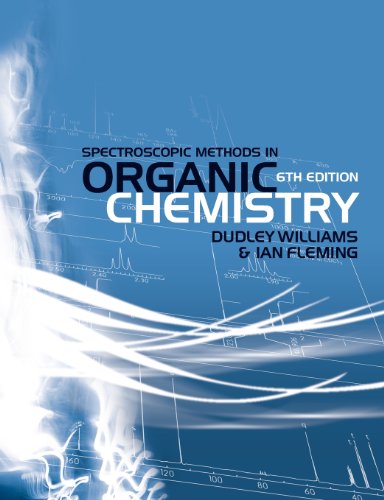
Spectroscopic Methods in Organic Chemistry
paperback
Published:
1 December, 2007


Popular Books by Ian Fleming
View All Books by Ian Fleming

Description
More Details
| Type | Book |
|---|---|
| ISBN13 | 9780077118129 |
| ISBN10 | 007711812X |
| Number Of Pages | 304 |
| Item Weight | 661 g |
| Product Dimensions | 188 x 20 x 242 mm |
| Publisher / Reseller | McGraw-Hill Higher Education |
| Format | paperback |
| Edition | 6 |
Author's Bio
Dudley Williams was an undergraduate at the University of Leeds (1955-1958), and obtained his PhD (1958-1961) there under the supervision of Professor Basil Lythgoe. Following postdoctoral research at Stanford University (1961-1964) with Professor Carl Djerassi, he followed an academic career in Cambridge, as a Fellow of Churchill College, and in the Department of Chemistry. His research involved developments in proton nuclear magnetic resonance and mass spectrometry, and, most famously, he and his co-workers elucidated the structure and mode of action of the clinically important antibiotic vancomycin. Ian Fleming studied at Pembroke College, Cambridge, obtaining his PhD in 1962 in the University Chemical Laboratory supervised by Dr John Harley-Mason. Except for a postdoctoral year at Harvard (1963-1964) with Professor R. B. Woodward, and sabbatical visits to McGill University in Montreal (1972 & 1978), the University of Wisconsin in Madison (1980), and Harvard University (1990), he has spent his entire academic career in Cambridge. In research, he is best known for his work on the application of organosilicon chemistry to solving problems of regiocontrol and stereocontrol in organic synthesis.