Traditional Construction Patterns
Traditional Construction Patterns
paperback
Published:
16 November, 2004

Popular Books by Susan Henderson
View All Books by Susan Henderson

Description
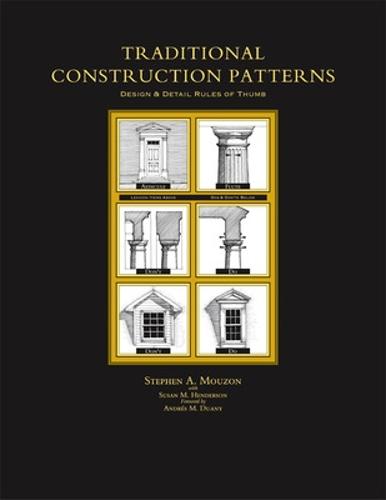
This handy, practical resource offers an illustrated, drill-down approach to the rules-of-thumb for details.
More Details
| Type | Book |
|---|---|
| ISBN13 | 9780071416320 |
| ISBN10 | 0071416323 |
| Number Of Pages | 312 |
| Item Weight | 715 g |
| Product Dimensions | 213 x 277 x 16 mm |
| Publisher / Reseller | McGraw-Hill Education - Europe |
| Format | paperback |
Media Reviews
"Putting the ideas of Modernism into the hands of average architects" and builders has resulted in "architecture done wrong for the past half-century." Architects Mouzon and Henderson explain their "sense of unease" and illustrate a range of do's and don'ts that "give people the tools for getting it right again." In 14 chapters they discuss architectural details ranging from the classical orders to roofs, site work, and signage. Powerful opening chapters set the stage by succinctly discussing architectural history, theory, themes and patterns. The Roman architect Vitruvius is cited, and his themes of commodity, firmness, and delight are expanded for application in reviving the lost language of architecture. The remaining eight chapters are clearly laid out with brief essays on architectural features; these are interspersed with excellent black-and-white photographs. All elements are examined using a technique incorporated into architecture: the transect, an organizing device for developing proper patterns. An illustrated lexicon is also included to educate laypersons in the language, but it is too detailed and selective to be as effective as desired. This is a great companion to Jonathan Hale's The Old Way of Seeing (1994) and the National Park Service's The Secretary of the Interior's Standards for Rehabilitation (rev., 1990). Summing Up: Highly recommended. General readers: upper-division undergraduates through professionals; two-year technical program students. -- L.B. Sickels-Taves, Eastern Michigan University Choice 20050301
Author's Bio
McGraw-Hill authors represent the leading experts in their fields and are dedicated to improving the lives, careers, and interests of readers worldwide