Obedience to Authority :An Experimental View
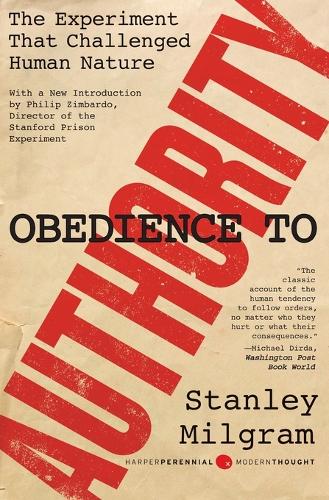
Obedience to Authority :An Experimental View
paperback
Published:
15 July, 2009

Popular Books by Stanley Milgram
View All Books by Stanley Milgram


Description
More Details
| Type | Book |
|---|---|
| ISBN13 | 9780061765216 |
| ISBN10 | 006176521X |
| Number Of Pages | 256 |
| Item Weight | 195 g |
| Product Dimensions | 135 x 203 x 15 mm |
| Publisher / Reseller | HarperCollins Publishers Inc |
| Format | paperback |
Media Reviews
“Milgram’s experiments on obedience have made us more aware of the dangers of uncritically accepting authority.” — Peter Singer, New York Times Book Review “Stanley Milgram’s experiments on obedience to malevolent authority seemed to me to be the most important social psychological research done in this generation….The quality of exposition in the book I s so high that it qualifies as literature as well as science.” — Roger Brown, Harvard University “This well-designed and brilliantly executed research study, reported in an unusually fascinating and very readable style, reveals the elusive and sometimes shocking conditions under which men obey authority regardless of the morality involved.” — Library Journal “A major contribution to our knowledge of man’s behavior. It establishes firmly in the front rank of social scientists in this generation.” — Jerome S. Brunner, Oxford University “One of the most significant books I have read in more than two decades of reviewing.” — Robert Kirsch, Los Angeles Times “The classic account of the human tendency to follow orders, no matter who they hurt or what their consequences.” — Michael Dirda, Washington Post Book World “Milgrim’s experiment-based analysis is a model of systematic, sequential, patient pursuit of answers to a significant social problem. His investigations accomplish what we should expect of responsible social science: to inform the intellect without trivializing the phenomenon.” — Henry W. Reicken, Science
GoodReads Reviews
Author's Bio
Stanley Milgram taught social psychology at Yale University and Harvard University before becoming a Distinguished Professor at the Graduate Center of the City University of New York. His honors and awards include a Ford Foundation fellowship, an -American Association for the Advancement of Science sociopsychological prize, and a Guggenheim fellowship. He died in 1984 at the age of fifty-one.