Ultra Wideband Wireless Body Area Networks
Ultra Wideband Wireless Body Area Networks
paperback
Published:
3 September, 2016

Popular Books by Jean-Michel Redoute
View All Books by Jean-Michel Redoute
Description
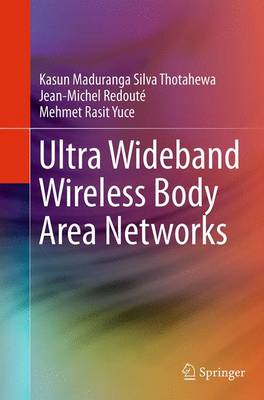
This book explores the design of ultra wideband (UWB) technology for wireless body-area networks (WBAN). The authors describe a novel implementation of WBAN sensor nodes that use UWB for data transmission and narrow band for data reception, enabling low power sensor nodes, with high data rate capability. The discussion also includes power efficient, medium access control (MAC) protocol design for UWB based WBAN applications and the authors present a MAC protocol in which a guaranteed delivery mechanism is utilized to transfer data with high priority. Readers will also benefit from this book’s feasibility analysis of the UWB technology for human implant applications through the study of electromagnetic and thermal power absorption of human tissue that is exposed to UWB signals.
More Details
| Type | Book |
|---|---|
| ISBN13 | 9783319353005 |
| ISBN10 | 3319353004 |
| Number Of Pages | 173 |
| Item Weight | 1000 g |
| Publisher / Reseller | Springer International Publishing AG |
| Format | paperback |
| Edition | Softcover reprint of the original 1st ed. 2014 |
Author's Bio
Kasun M. S. Thotahewa received BSc. Hons. Degree in Electronic and Telecommunications from University of Moratuwa, Sri Lanka in July 2008, and the Ph.D. degree in Electrical Engineering from Monash University, Melbourne, Australia in March 2014. He has worked as a network operations engineer in one of the major mobile service providers in Sri Lanka. His research interests are in UWB wireless communication, wireless body area networks, bio-electromagnetism and radio frequency circuit design.
Mehmet Rasit Yuce received the M.S. degree in Electrical and Computer Engineering from the University of Florida, Gainesville, Florida in 2001, and the Ph.D. degree in Electrical and Computer Engineering from North Carolina State University (NCSU), Raleigh, NC in December 2004. He was a post-doctoral researcher in the Electrical Engineering Department at the University of California at Santa Cruz in 2005. He was a Senior Lecturer in the School of Electrical Engineering and Computer Science, University of Newcastle, New South Wales, Australia until Jul 2011. In July 2011, he joined the Department of Electrical and Computer Systems Engineering, Monash University, Melbourne Australia. His research interests include wireless implantable telemetry, wireless body area network (WBAN), bio-sensors, MEMs sensors, integrated circuit technology dealing with digital, analog and radio frequency circuit designs for wireless, biomedical, and RF applications. Dr. Yuce has published more than 100 technical articles in the above areas and received a NASA group achievement award in 2007 for developing an SOI transceiver. He received a research excellence award in the Faculty of Engineering and Built Environment, University of Newcastle in 2010. He is a senior member of IEEE. He is an associate editor for IEEE Sensors Journal.
Jean-Michel Redouté received the degree of M. S. in electronics at the University College of Antwerp, in 1998, and the degree of M.Eng. in electrical engineering at the University of Brussels, in 2001. In August 2001, he started working at Alcatel Bell in Antwerpen, where he was involved in the design of analog microelectronic circuits for telecommunications systems. In January 2005, he joined the ESAT-MICAS laboratories of the Katholieke Universiteit Leuven as a Ph. D. research assistant. In May 2009, he obtained his Ph. D. entitled "Design of EMI resisting analog integrated circuits". In September 2009, he started working at the Berkeley Wireless Research Center at the University of California, at Berkeley as a postdoctoral scholar. In September 2010, he joined Monash University as a senior lecturer. His research interests include mixed-signal integrated circuit (IC) design, electromagnetic compatibility (EMC), biomedical (integrated and non-integrated) circuit design and radio frequency integrated circuit design.