Numerical Modelling of Astrophysical Turbulence - SpringerBriefs in Astronomy
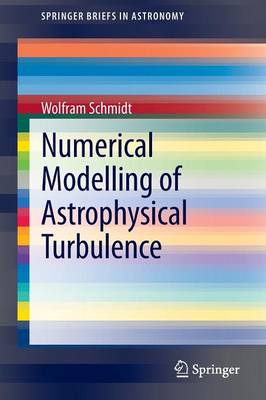
Numerical Modelling of Astrophysical Turbulence - SpringerBriefs in Astronomy
paperback
Published:
7 October, 2013

Popular Books by Wolfram Schmidt
View All Books by Wolfram Schmidt
Description
In this "SpringerBrief" the author considers the underlying problems and questions that are common to numerical models of turbulence in different astrophysical systems.
Turbulence has emerged as an important research topic in several areas of astrophysics. Understanding and modeling turbulence is particularly important for the dynamics of the interstellar medium, but also for the intergalactic medium, as well as in stars. The advancement of methods for numerical simulations of astrophysical turbulence, however, is still challenging because of gravity, strong compressibility, magnetic fields, and other effects.
The book begins with a review of general aspects of numerical simulations of turbulence. In the main part the author presents findings from his numerical studies on astrophysical turbulence and discusses the astrophysical implications. He also explains in detail the numerical schemes utilized.
Readers will find that this book offers a compact yet comprehensive introduction.
More Details
| Type | Book |
|---|---|
| ISBN13 | 9783319014746 |
| ISBN10 | 3319014749 |
| Number Of Pages | 90 |
| Item Weight | 1000 g |
| Publisher / Reseller | Springer International Publishing AG |
| Format | paperback |
Media Reviews
“This book provides an interesting and well-written account on an area witnessing encouraging progress.” (H. Muthsam, Monatshefte für Mathematik, 2016)
“The primary focus of this book is on the numerical methods and their application in studying the fundamental statistical properties of compressible hydrodynamic turbulence. … The book can be a useful survey and reference source for researchers in the field. Also, it can be a good point of introduction for someone wanting to develop a research capability in this area.” (Stephen Wollman, zbMATH 1317.85004, 2015)