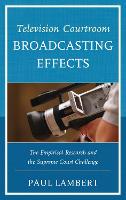
Television Courtroom Broadcasting :Distraction Effects and Eye-Tracking
Television Courtroom Broadcasting :Distraction Effects and Eye-Tracking
hardback
Published:
15 December, 2012

Popular Books by Paul Lambert
View All Books by Paul Lambert

Description
More Details
| Type | Book |
|---|---|
| ISBN13 | 9781841506470 |
| ISBN10 | 1841506478 |
| Number Of Pages | 223 |
| Item Weight | 581 g |
| Product Dimensions | 178 x 229 x 14 mm |
| Publisher / Reseller | Intellect |
| Format | hardback |
Media Reviews
'In Television Courtroom Broadcasting: Distraction Effects and Eye Tracking, Paul Lambert tackles a very sensitive and controversial topic - Television Courtroom Broadcasting and its effects, which has been actively or passively ostracized not only by government, law departments, but by the scientific community as well. With this book, he showed that a New World of research on the effects of in-court distraction is waiting. In fact, “eye tracking kills the subjective reports stars” and eye movements, as true direct measure of importance, should serve in future, as a reliable source of information for Judges, Lawyers and Policy-makers.'
-- Pedro J. Rosa Clinical Psychologist, MSc'Lambert has provided a strong argument for the experimental study of distraction in the courtroom due to television broadcasting. Specifically, he makes a compelling case for the use of eye tracking technology as one of the key methods to be employed. This initial foray into courtroom distraction is likely to encourage those involved in courtroom activities to pursue experimental evidence for distraction, and to encourage those engaged in applied research methods to consider the courtroom as an exciting new field to exercise their hypotheses. As a focal point for bringing these two groups together, this book cannot be faulted, and we will hopefully see a new field of courtroom research develop over the next decade which will trace its lineage back to this publication.'
-- Dr. David Crundall Director of the Nottingham Integrated Transport and Environment Simulation facility (NITES), University of Nottingham'It does well in emphasising the need for further empirical research in this area and the valuable role eye tracking technology can play in this debate'
-- SCRIPTed, Yolande Stolte'A very useful book'
-- Revista Aranzadi de derecho y nuevas tecnologías / Journal Aranzadi of Rights and New Technologies, Jose M. Baños FosAuthor's Bio
Paul Lambert is a lecturer, lawyer and writer.