Cost–Benefit Analysis - Elements in Public Economics
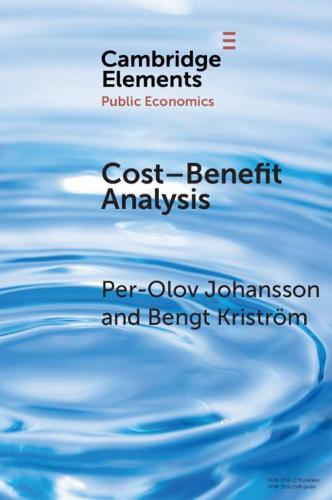
Cost–Benefit Analysis - Elements in Public Economics
paperback
Published:
24 May, 2018

Popular Books by Per-Olov Johansson
View All Books by Per-Olov Johansson
Description
More Details
| Type | Book |
|---|---|
| ISBN13 | 9781108462938 |
| ISBN10 | 1108462936 |
| Number Of Pages | 102 |
| Item Weight | 160 g |
| Product Dimensions | 151 x 229 x 6 mm |
| Publisher / Reseller | Cambridge University Press |
| Format | paperback |
Media Reviews
'The authors' ability to address classic topics in a simple illustrative manner that nevertheless leads to very penetrating conclusions is the mark of their deep understanding of the matter. … [T]he authors demonstrate an enviable ability to explain concepts and mechanisms with very simple sentences and examples. They do not hesitate to return to the definition of rather basic concepts, such as externalities, or public goods, using enlightening illustrations. They introduce more refined concepts with short sentences. I was especially struck by their elegant and concise way of introducing risk: 'In order to be able to say anything meaningful about attitudes toward risk we must assume that the utility function is concave or convex. Concavity or convexity of a function is a cardinal property. Therefore we now leave the ordinal world …'' Emile Quinet, Society for Benefit-Cost Analysis (benefitcostanalysis.org)