Television Courtroom Broadcasting Effects :The Empirical Research and the Supreme Court Challenge
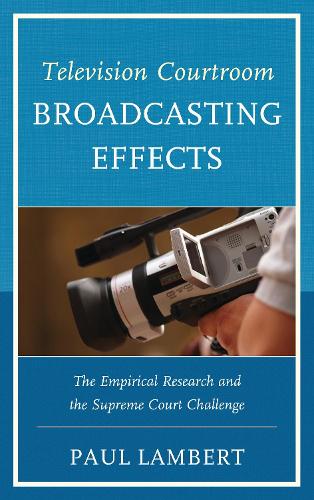
Television Courtroom Broadcasting Effects :The Empirical Research and the Supreme Court Challenge
paperback
Published:
1 April, 2015

Popular Books by Paul Lambert
View All Books by Paul Lambert

Description
More Details
| Type | Book |
|---|---|
| ISBN13 | 9780761865582 |
| ISBN10 | 0761865586 |
| Number Of Pages | 494 |
| Item Weight | 730 g |
| Product Dimensions | 153 x 225 x 35 mm |
| Publisher / Reseller | University Press of America |
| Format | paperback |
Media Reviews
This book is a corrective. First, it recounts the arguments for and against television in courtrooms, and reveals most of them to be self-serving assertions with next to no evidence to support them. Second, it takes the claims and counterclaims seriously, and sets out a sensible approach to replace hot air with hard evidence. This topic is timely. Courts are under pressure to revise their rules. It will become the indispensable read for everyone interested in the topic. * The Barrister *
It recounts the arguments for and against. . . and reveals most of them to be self-serving assertions with next to no evidence to support them. . . it takes the claims and counterclaims seriously, and sets out a sensible approach to replace hot air with hard evidence. This topic is timely. Courts are under pressure to revise their rules. It will become the indispensible read for everyone interested in the topic. -- Malcolm M. Feeley, Claire Sanders Clements Dean’s Professor, Jurisprudence and Social Policy Program, Boalt Hall, University of California Berkeley
Questions many of the assumptions. . . as well as raising several other issues that have not been extensively addressed. . . a new, interesting and useful perspective to the discussion and debate. -- Eric P. Robinson, deputy director, Reynolds National Center for Courts and Media; managing editor, Reynolds Courts and Media Law Journal
[This book] is the most comprehensive research-based assessment of the pros and cons of television broadcasting available on the market today. . . All those of us with an interest in open justice will welcome this book as making a major contribution to the debate, being perhaps the only book on the market that provides a totally objective assessment of the evidence to date. -- Duncan Bloy, Ph.D., School of Journalism, Media and Cultural Studies, Cardiff University; co-author Hadwin and Bloy: Law and the Media, Second Edition
An essential read for anyone interested in justice and the media in the twenty-first century. -- Glen Creeber, Ph.D., senior lecturer in television studies, Aberystwyth University; author of The Television Genre Book and Studying Television: An Introduction
Author's Bio
Paul Lambert is a lawyer and academic specializing in media, intellectual property, and information technology law.