The Color of School Reform :Race, Politics, and the Challenge of Urban Education
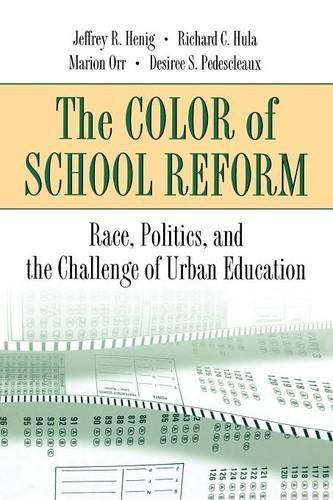
The Color of School Reform :Race, Politics, and the Challenge of Urban Education
paperback
Published:
26 February, 2001

Popular Books by Jeffrey R. Henig
View All Books by Jeffrey R. Henig
Description
Prizes
Winner of American Political Science Association Urban Politics Section: Best Book Award 2000
More Details
| Type | Book |
|---|---|
| ISBN13 | 9780691088976 |
| ISBN10 | 0691088977 |
| Number Of Pages | 320 |
| Item Weight | 425 g |
| Publisher / Reseller | Princeton University Press |
| Format | paperback |
Media Reviews
Winner of the 2000 Best Book Award, Urban Politics Section of the American Political Science Association "[The authors] have plainly done their homework. They have reviewed thousands of news clips and official reports, conducted scores of interviews and surveyed a wide array of influential actors... Although the authors are plainly sympathetic to the aspirations of the reformers, they have checked their dreams at the door. That they do not shy away from telling inconvenient truths ... gives them greater credence to their account."--David L. Kirp, The Nation "This substantial volume does not leave the reader with great optimism. Rather, The Color of School Reform extends our understanding of the roots of urban school failure and broadens our focus on the political and social requisites for successful reform. At this stage of the big city school wars, that's a more important contribution."--Michael F. Addonizio, Qualitative Studies in Education
Author's Bio
Jeffrey R. Henig is Professor of Political Science and Director of the Center for Washington Area Studies at George Washington University and author of Rethinking School Choice Richard C. Hula is Professor of Political Science and Urban Affairs at Michigan State and author of Market-Based Public Policy and The Reconstruction of Family Policy. Marion Orr is Associate Professor of Political Science and Urban Studies at Brown University and author of Black Social Capital. Desiree S. Pedescleaux is Assistant Professor of Political Science at Spelman College.