Studies in Tectonic Culture :The Poetics of Construction in Nineteenth and Twentieth Century Architecture - Studies in Tectonic Culture
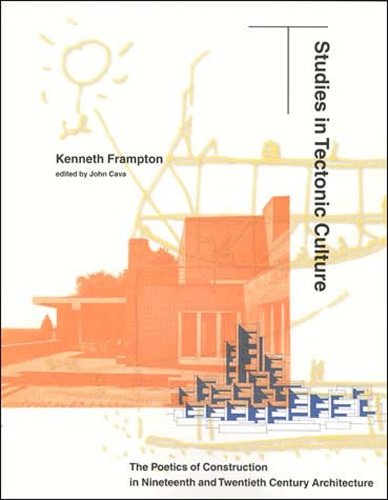
Studies in Tectonic Culture :The Poetics of Construction in Nineteenth and Twentieth Century Architecture - Studies in Tectonic Culture
paperback
Published:
24 August, 2001

Popular Books by Kenneth Frampton
View All Books by Kenneth Frampton

Description
Composed of ten essays and an epilogue that trace the history of contemporary form as an evolving poetic of structure and construction, the book's analytical framework rests on Frampton's close readings of key French and German, and English sources from the eighteenth century to the present.
Kenneth Frampton's long-awaited follow-up to his classic A Critical History of Modern Architecture is certain to influence any future debate on the evolution of modern architecture. Studies in Tectonic Culture is nothing less than a rethinking of the entire modern architectural tradition. The notion of tectonics as employed by Frampton—the focus on architecture as a constructional craft—constitutes a direct challenge to current mainstream thinking on the artistic limits of postmodernism, and suggests a convincing alternative. Indeed, Frampton argues, modern architecture is invariably as much about structure and construction as it is about space and abstract form.
Composed of ten essays and an epilogue that trace the history of contemporary form as an evolving poetic of structure and construction, the book's analytical framework rests on Frampton's close readings of key French and German, and English sources from the eighteenth century to the present. He clarifies the various turns that structural engineering and tectonic imagination have taken in the work of such architects as Perret, Wright, Kahn, Scarpa, and Mies, and shows how both constructional form and material character were integral to an evolving architectural expression of their work. Frampton also demonstrates that the way in which these elements are articulated from one work to the next provides a basis upon which to evaluate the works as a whole. This is especially evident in his consideration of the work of Perret, Mies, and Kahn and the continuities in their thought and attitudes that linked them to the past.
Frampton considers the conscious cultivation of the tectonic tradition in architecture as an essential element in the future development of architectural form, casting a critical new light on the entire issue of modernity and on the place of much work that has passed as "avant-garde."
A copublication of the Graham Foundation for Advanced Studies and The MIT Press.
Prizes
Winner of Honorable Mention, 1995, in the category of Excellence in Design and Production, Professional/Scholarly Publishing Annual Awards Competition presented by the Association of American Publishers, Inc. 1995
More Details
| Type | Book |
|---|---|
| ISBN13 | 9780262561495 |
| ISBN10 | 0262561492 |
| Number Of Pages | 448 |
| Item Weight | 1451 g |
| Product Dimensions | 216 x 279 x 22 mm |
| Publisher / Reseller | MIT Press Ltd |
| Format | paperback |
Media Reviews
"Kenneth Frampton's book approaches a very importantissue for understanding the way in which architects proceed: the continuity between form and construction. But to establish this continuity doesn't simply mean to accept pure constructive determinism, and Frampton's book helps us to comprehend that beside whatever technical discovery there is always the architect's effort to produce form. Using the work of outstanding contemporary architects such as Utzon and Scarpa, Frampton is able to show how architectural talent is manifested in continuous form invention." Rafael Moneo , Professor of Architecture, Harvard University "Kenneth Frampton's book approaches a very important issue for understanding the way in which architects proceed: the continuity between form and construction. But to establish this continuity doesn't simply mean to accept pure constructive determinism, and Frampton's book helps us to comprehend that beside whatever technical discovery there is always the architect's effort to produce form. Using the work of outstanding contemporary architects such as Utzon and Scarpa, Frampton is able to show how architectural talent is manifested in continuous form invention." Rafael Moneo, Professor of Architecture, Harvard University
GoodReads Reviews
Author's Bio
Kenneth Frampton is Ware Professor of Architecture at Columbia University.